General Chair of EAI SecureComm 2026
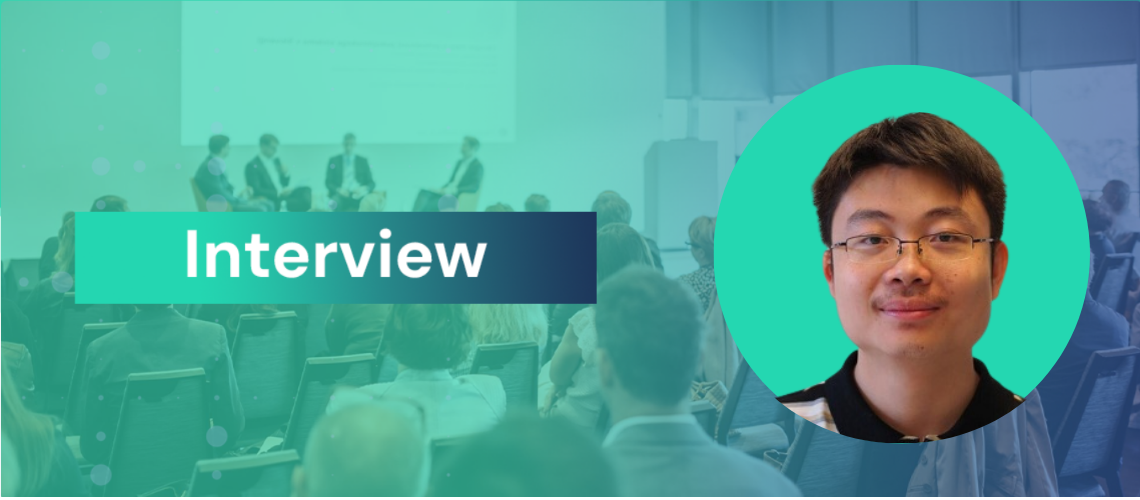
As part of our new Voices of the EAI Community series, we are delighted to introduce the people behind EAI conferences, journals, and research initiatives. Our first guest is Prof. Weizhi Meng, General Chair of SecureComm 2026 and Full Professor at Lancaster University. In this conversation, he reflects on his international academic journey, his long-standing involvement with EAI, the future of cybersecurity in the age of AI, and why strong research communities matter more than ever.
Behind every successful conference is a community of researchers who continue to exchange ideas long after the closing session. For Prof. Weizhi Meng, General Chair of EAI SecureComm 2026 and Full Professor at Lancaster University, that sense of community has shaped an academic career spanning multiple countries, institutions, and research collaborations. Having studied and worked across Asia and Europe, Prof. Meng has witnessed first-hand how different research cultures approach scientific collaboration. From his early work in Asia to research positions in Denmark and now the United Kingdom, each step has broadened not only his research interests but also his understanding of how international communities drive scientific progress.
“The international experience allowed me to build collaborations with researchers from many different countries. It helped me understand different research cultures and how to evaluate ideas from different perspectives.”
A curiosity that became a career
When Prof. Meng first became interested in cybersecurity, the field looked very different from today.
“As a student, I noticed that more and more systems were becoming connected, yet security vulnerabilities were everywhere,” he recalls. “At that time, cybersecurity was still an emerging topic, but I had the feeling it would become increasingly important.”
That instinct proved to be remarkably accurate.
Today, cybersecurity sits at the centre of digital transformation, from smart cities and connected devices to artificial intelligence and critical infrastructure. Throughout his career, Prof. Meng has continued to evolve alongside the field, expanding his research beyond intrusion detection into areas including IoT security, biometric authentication, blockchain technologies, and AI-driven security solutions.
His contributions have earned international recognition, including the IEEE Communications Society (ComSoc) EMEA Outstanding Young Researcher Award, reflecting both the quality and impact of his research.
A journey with EAI
Prof. Meng’s relationship with EAI began more than a decade ago when he attended SecureComm 2012 in Padua, Italy.
“It was my first EAI conference, and I had a very good experience,” he says.
Since then, his involvement has steadily grown-from author and committee member to conference organiser, Editor-in-Chief of an EAI journal, and now General Chair of SecureComm 2026.
One milestone he remembers particularly fondly was founding EAI BlockTEA, a conference series that continues to thrive today.
“It’s rewarding to see that the conference is still growing,” he says. “Even today I’m happy to continue contributing to its development.”
Looking ahead to SecureComm 2026
This year’s SecureComm marks another important milestone as the conference comes to Lancaster University for the first time.
For Prof. Meng, maintaining the conference’s long-standing reputation is a top priority.
“SecureComm has built a strong reputation over many years,” he explains. “Our goal is to maintain the highest quality of accepted papers while adapting to new challenges, including the rapid development of AI.”
With artificial intelligence becoming an increasingly common tool in scientific writing, ensuring research integrity has become more important than ever. The programme committee has therefore placed particular emphasis on maintaining rigorous peer review and publication standards.
Beyond the scientific programme, however, Prof. Meng hopes participants will remember something else.
“Lancaster offers a different conference experience,” he says. “It’s a beautiful university city close to the Lake District, providing a relaxed environment where researchers can focus on meaningful discussions, networking, and collaboration.”
Artificial intelligence: opportunity and responsibility
Few technologies are transforming cybersecurity as rapidly as artificial intelligence.
For Prof. Meng, AI is both an opportunity and a responsibility.
On one hand, AI tools have become valuable assistants, helping researchers improve writing quality, analyse ideas, and accelerate certain parts of the research process.
On the other hand, they also introduce new ethical challenges. “As reviewers and conference organisers, we have to ensure that AI supports research rather than replaces genuine scientific contribution,” he explains. “Maintaining research quality and integrity is becoming increasingly important.”
Building communities that last
Throughout the conversation, one theme returned repeatedly: community.
For Prof. Meng, successful conferences are built not only on excellent papers, but on active researchers who continue returning, collaborating, and contributing year after year.
“A strong research community depends on active people who trust the event, contribute to it, and remain engaged,” he says. “It’s important that we continue finding ways to motivate researchers and help them feel part of the community.”
His advice for young researchers is equally straightforward.
Attend conferences whenever possible.
Meet people.
Ask questions.
Build collaborations.
“Meeting experts, attending keynote talks, discussing research ideas, and becoming involved in the community can shape your career in ways that publications alone cannot.”
As SecureComm 2026 approaches, Prof. Meng hopes attendees will leave Lancaster with more than new research insights.
He hopes they will leave with new ideas, new collaborators, and perhaps the beginning of a research community that will continue growing for years to come.
About SecureComm 2026
EAI SecureComm 2026 will take place 21–24 July 2026 at Lancaster University, United Kingdom, bringing together researchers, practitioners, and industry experts to discuss the latest advances in cybersecurity, privacy, network security, and trustworthy computing.