
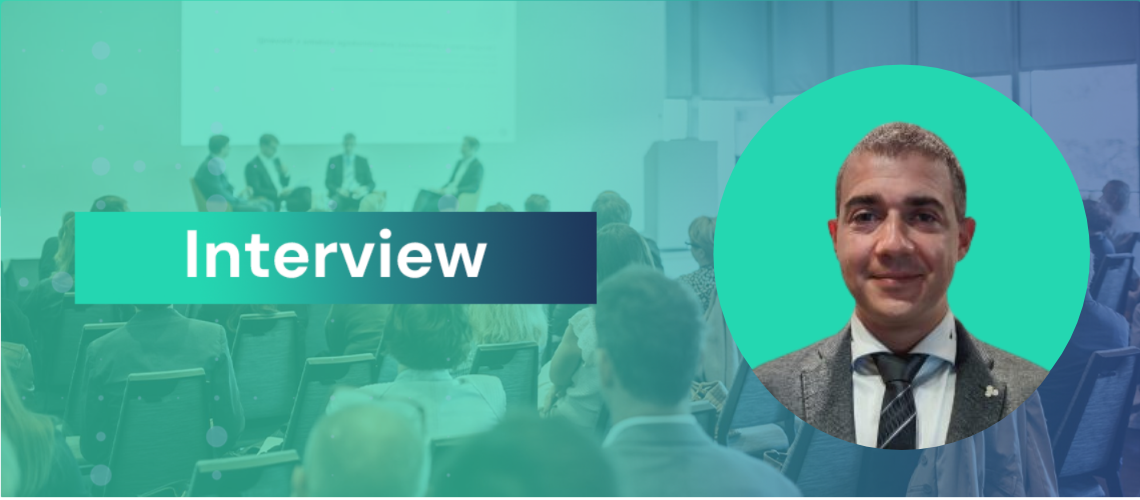
What began as a road safety project eventually led Stefano Caputo into the world of wireless communications, medical devices and an international research community he now helps lead.
Stefano Caputo didn’t set out to become a telecommunications researcher. He studied mechanical engineering, worked in industry, and initially had quite different plans for his career.
Today he’s an Assistant Professor at the University of Florence, researching how wearable and implantable medical devices communicate. He’s also the General Chair of EAI BODYNETS 2026, a conference he first helped organize seven years ago.
We caught up with Stefano ahead of this year’s event in Florence to talk about how he got here, the research he’s working on, and why he still considers meeting other researchers in person an essential part of his job.
A Career That Took an Unexpected Turn
It started with his master’s thesis.
While working on a road safety application, Stefano met researchers who introduced him to optical communication technologies. He spent six months studying optical systems in the Department of Physics, an experience that changed his plans.
Instead of continuing in mechanical engineering, he decided to pursue a PhD in telecommunications.
That decision eventually led him to Body area Networks a field concerned with how devices worn on or implanted inside the human body exchange information.
Much of Stefano’s research now focuses on alternatives to conventional radio-frequency communication. One example is Visible Light Communication (VLC), which uses light to transmit data.
As smartwatches, health-monitoring devices, and implantable technologies become more common, researchers need to find ways for these devices to communicate reliably. Stefano is exploring how optical and other communication methods could work alongside existing wireless technologies.
Interestingly, his mechanical engineering background still comes in handy, particularly when his research takes him into areas such as molecular communication.
It’s a career that has moved between several disciplines, and Stefano doesn’t seem particularly interested in staying within the boundaries of just one.
Seven Years of BODYNETS
Stefano first became involved with BODYNETS in the year 2019 serving as Web Chair when the conference was held in Florence.
Last year, he was a keynote speaker at the edition in Japan, where he presented his work on optical wireless communications for devices worn on or implanted in the body.
This December BODYNETS returns to Florence, this time with Stefano as General Chair.
He’s seen some changes since his first involvement. The core community is still there, but the research being presented has become more varied. Alongside medical researchers, the conference now attracts more specialists in computer science, electronics, communication technologies, and artificial intelligence.
Stefano would like to see that exchange continue beyond the conference itself. He also serves as Editor-in-Chief of EAI Endorsed Transactions on Body Area Networks, a journal he hopes will become another meeting point for researchers in the field.
Some Connections Are Better Made in Person
When we asked Stefano about the value of research conferences, he brought up the years following the 2019 edition.
Like many academic events, BODYNETS moved online during the pandemic. Research continued, but Stefano felt that opportunities to build collaborations became more limited.
He gave us an example from his own experience. Researchers he first met at BODYNETS in Florence in 2019 later became collaborators on work involving alternative wireless communication technologies.
It’s the kind of connection that can begin with a conversation at a conference and turn into a research project years later.
Stefano estimates that he has worked with around 120 different co-authors throughout his career. He prefers working with other researchers to working alone, partly because each collaboration introduces him to different methods and subjects.
His advice to young researchers follows naturally from that experience:
“Attend conferences, meet people, and work with colleagues outside your immediate area of expertise. My own career changed direction thanks to the people I met while working on my master thesis.“
What to Expect from BODYNETS 2026
For this year’s conference Stefano has made security one of the main discussion topics.
With wearable and implantable devices increasingly used to collect medical information, he believes security needs much more attention. A connected medical device isn’t simply another piece of consumer technology. The consequences of unreliable or insecure communication can be far more serious.
The BODYNETS 2026 program will therefore include dedicated discussions on privacy, safety, trust and cybersecurity, bringing together researchers from different technical backgrounds.
We also asked Stefano about artificial intelligence in healthcare, particularly where he sees the biggest challenges.
“I expect AI to become increasingly relevant to medical monitoring. However, using algorithms to support monitoring and alerts is one thing, and developing AI systems that can make reliable medical diagnoses is quite another.” he explained.
Questions of reliability, ethics, and regulation make the second considerably more complicated.
These are precisely the kinds of discussions he wants BODYNETS to encourage, with researchers looking at the same problems from different perspectives.
Back to Florence
For Stefano, BODYNETS 2026 brings things back to where his involvement with the conference began.
In 2019 he was experiencing conference organization for the first time. Seven years later, he’s leading the event in his home city, with a wider research community and a program that reflects how much the field has changed.
And while much of his work is about finding better ways for devices to communicate, our conversation kept returning to the importance of people communicating with each other.
With around 120 co-authors, several changes in research direction, and seven years of involvement with BODYNETS, Stefano has plenty of experience to support that view.