

Research from the Mood and Money Lab, University College Dublin was recognised with the Best Paper Award at EAI Pervasive Health 2026 for their innovative research exploring the relationship between financial behaviour and mental health in bipolar disorder. In this article, Oluwadara Adedeji shares insights from the research and key findings from the award-winning work presented at the conference.
Why money and mood?
Mood and money are closely linked in bipolar disorder, a mental health condition characterised by episodes of depression and mania or hypomania, involving significant changes in mood, energy, and behaviour. These episodes can influence financial decisions, from impulsive spending during elevated moods to reduced spending, withdrawal, or financial inactivity during depressive phases. The stakes are high: people with bipolar I disorder have roughly 50% higher odds of bankruptcy than the general population. Yet little is known about the specifics: which kinds of spending change, and how a mood episode unfolds into spending.
What did the study do?
Open banking now makes objective, timestamped transaction data available at scale, raising the prospect of using spending as a passive, low-burden signal of mood. Before developing such models, we sought to understand the experiences of the people they would serve. We interviewed 19 adults with bipolar disorder across the UK (11), Ireland (4), and Nigeria (4), exploring how mood influences financial behaviour, what spending patterns might signal mood changes, and participants’ willingness to share financial data. Participants were also shown three versions of financial data, ranging from detailed transactions to aggregated summaries, to understand their privacy preferences.
What makes this research different?
While previous studies have explored the relationship between financial behaviour and mental health, our research goes further by identifying specific financial patterns that could serve as computational indicators of mood changes in bipolar disorder. A key innovation is our human-centred approach to feature engineering, translating participants’ lived experiences into potential features for machine learning models. We also examine the practical and ethical requirements for sharing financial data, providing insights into how future monitoring systems can be designed to be both clinically meaningful and acceptable to users. Together, these contributions lay the groundwork for developing personalised, privacy-sensitive systems that could use financial data to detect changes in mood and potentially support early intervention.
What drives spending
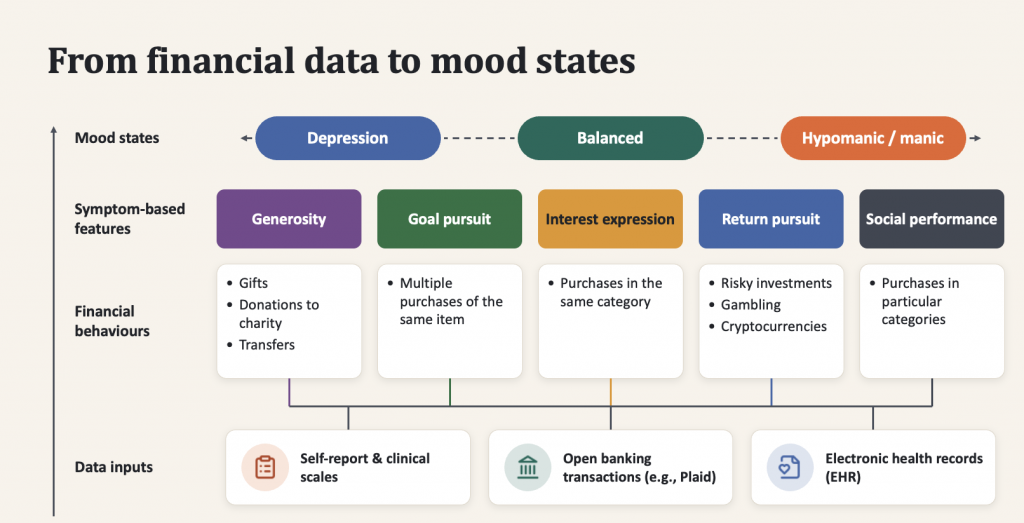
All 19 participants said mood strongly influences their financial behaviour. In elevated mood, the drivers they described were:
- Seeking fun, joy or pleasure (5 participants)
- Loneliness, boredom or insomnia (5), often late-night scrolling into frictionless online spending
- Acts of generosity, such as gifts, donations and transfers (4)
- Striving for social acceptance (3)
- Goal pursuit driven by grandiose thinking (2)
- Risk-taking, such as gambling, risky investments or crypto (2)
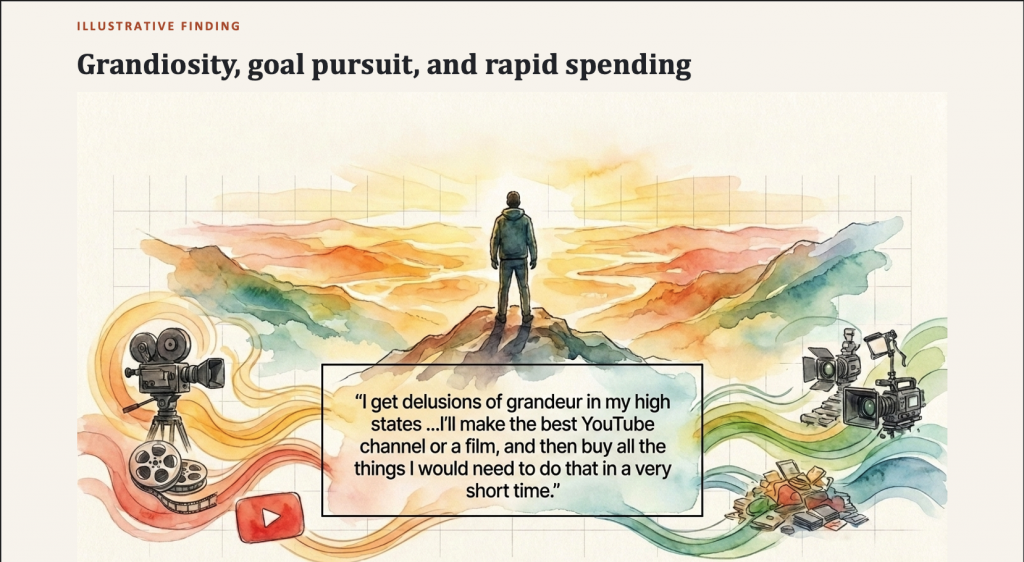
Three participants described a self-reinforcing loop: elevated mood leads to spending, and the “dopamine hit” from buying lifts mood further. As one put it: “I get delusions of grandeur in my high states … I’ll make the best YouTube channel or a film, and then buy all the things I would need to do that in a very short time.”
Context mattered too, including income, access to credit, timing and seasonality, and local economies, such as the role of cash in Nigeria.
From Lived Experiences to Computational Features: A Human-Centred Approach
Traditional approaches to analysing financial data often focus on statistical measures such as transaction frequency, amounts, and spending patterns. Our research goes a step further by drawing on the lived experiences of people with bipolar disorder to identify meaningful financial behaviours that could indicate mood changes.
For example, increased generosity during elevated moods could manifest as frequent transfers to individuals, while insomnia-related spending might appear as unusual late-night transactions. Similarly, depressive episodes could be reflected in reduced spending or increased purchases of convenience items.
By translating these lived experiences into potential computational features for machine learning models, we aim to develop mood-monitoring systems that are more personalised, interpretable, and grounded in the experiences of the people they are designed to support.
What it means for modelling
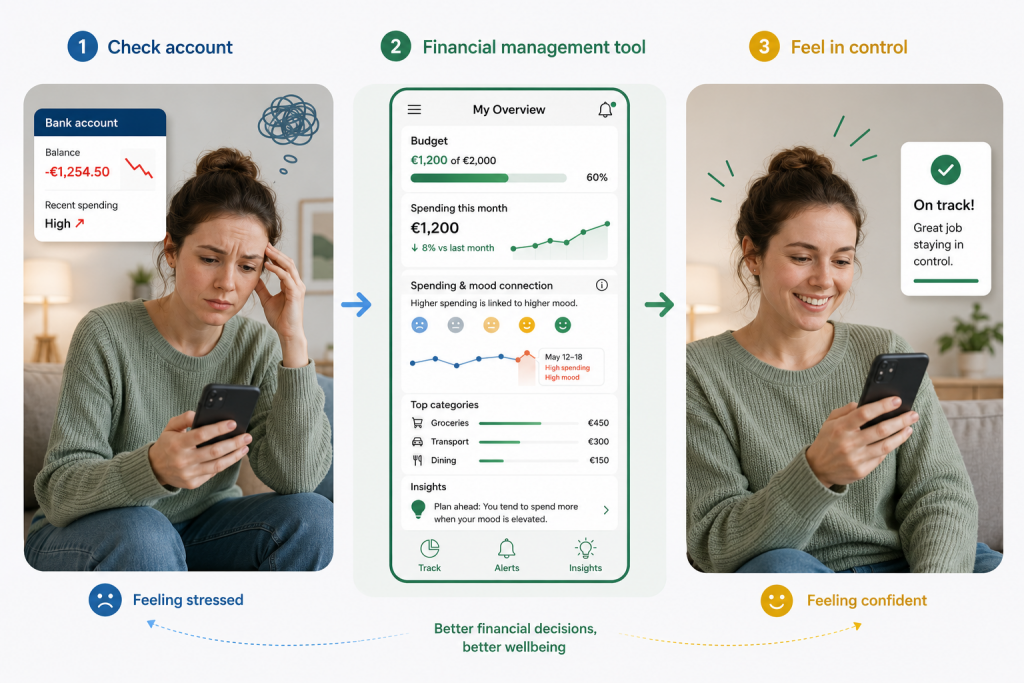
Mood shapes spending in idiosyncratic ways, which points to models that are personal rather than one-size-fits-all. Depressive spending is not simply the inverse of manic spending, so it needs its own features. Individual baselines, or multilevel models that share strength across people, may capture within-person change better. Spending categories, time of day, seasonality and anomaly detection could sharpen the signal, while low-burden tools such as SMS diaries can capture cash spending so no one is excluded.
What People Are Willing to Share
Access to financial data remains a major challenge in this field, making it essential to understand people’s willingness to share their data for research. Encouragingly, most participants were open to sharing, but on their own terms. Of the 19 participants, 13 expressed willingness to share their financial data, five would do so only with clear privacy and security safeguards, and one preferred manual sharing.
Participants also had preferences about the level of detail they were comfortable sharing. The most popular option, preferred by nine participants, replaced merchant names with spending categories, while four had no specific preference. Trust, transparency, and control were important, with familiar institutions such as charities and universities helping to encourage willingness to share.
This matters because acceptance comes first: a model cannot help people who will not share their data.

Why We Chose PervasiveHealth 2026
We chose EAI PervasiveHealth 2026 because its theme, “Intelligent, Inclusive & Sustainable Digital Healthcare,” closely aligns with our research vision of using everyday financial data to support prevention and early intervention in mental healthcare. Our work also emphasises developing ethical, inclusive, and human-centred technologies grounded in lived experiences.
The conference also offered an opportunity to engage with researchers, clinicians, and industry professionals at the intersection of technology and healthcare, exchange ideas, receive feedback, and build networks for potential interdisciplinary collaborations.
What's next
The next step is to test these candidate features as computational signals using objective, consented financial data. The team’s conclusion: financial behaviour is a promising signal for passive mental health assessment in bipolar disorder, but only if modelling stays clinically grounded and ethically acceptable.
PervasiveHealth comes to Ireland next year, with the 2027 conference taking place in Cork in October.
The work is funded by Research Ireland through ML-Labs, the Research Ireland Centre for Research Training in Machine Learning.
Find out more about the lab at moodmoney.ucd.ie.

Oluwadara Adedeji
University College Dublin
Oluwadara Adedeji is a PhD researcher in Computer Science at University College Dublin, Ireland, affiliated with the ML-Labs Centre for Research Training. His research focuses on applying machine learning to financial transaction data for the early detection of mood changes in bipolar disorder, with an emphasis on human-centred design, privacy, and responsible AI. He holds an MSc in Engineering Artificial Intelligence from Carnegie Mellon University Africa and a First Class BSc in Electrical and Electronic Engineering from the University of Ibadan, Nigeria. Driven by a passion for improving mental healthcare, he has over three years of volunteering experience in mental health advocacy and support, working with organisations such as Aware Ireland and Mentally Aware Nigeria Initiative (MANI). His commitment to mental health extends beyond research, reflecting his belief in the importance of prevention, early intervention, and accessible mental healthcare.